 Romford Electrical Services
Romford, East London
Consumer Unit Upgrades in Romford RM1
The consumer unit, often still called the fuse box, is the control point for every circuit in your property.
- Send a short enquiry
- Covering East London
- EICR and related services
Replacing an old fuse box with a modern consumer unit
Romford Electrical Services handles consumer unit upgrades for homes and other properties in Romford, Hornchurch, Upminster, Gidea Park and Harold Wood. This page explains what the work involves and when it makes sense to send an enquiry.
What happens, step by step
Every property is different, but a typical consumer unit upgrade runs along these lines.
| Step | What happens |
|---|---|
| 1. Enquiry | You send the enquiry form with your address area, a description of the current fuse box and the reason you want the upgrade. |
| 2. Details and scope | The existing set-up is discussed, including the number of circuits, the board position and any inspection report you already hold. |
| 3. Agreeing the work | The consumer unit replacement is described as its own job, with any extra work that may be needed listed separately. |
| 4. Isolating and replacing | The supply is switched off, the old unit is removed and the new one is fitted and the circuits are reconnected. |
| 5. Testing | The circuits are tested before the power is switched back on and the new unit is explained to you. |
| 6. Paperwork | The paperwork for the work is completed and passed to you to keep. |
Steps and order can vary with the property and what is found when the old board is opened up.
What a consumer unit upgrade involves
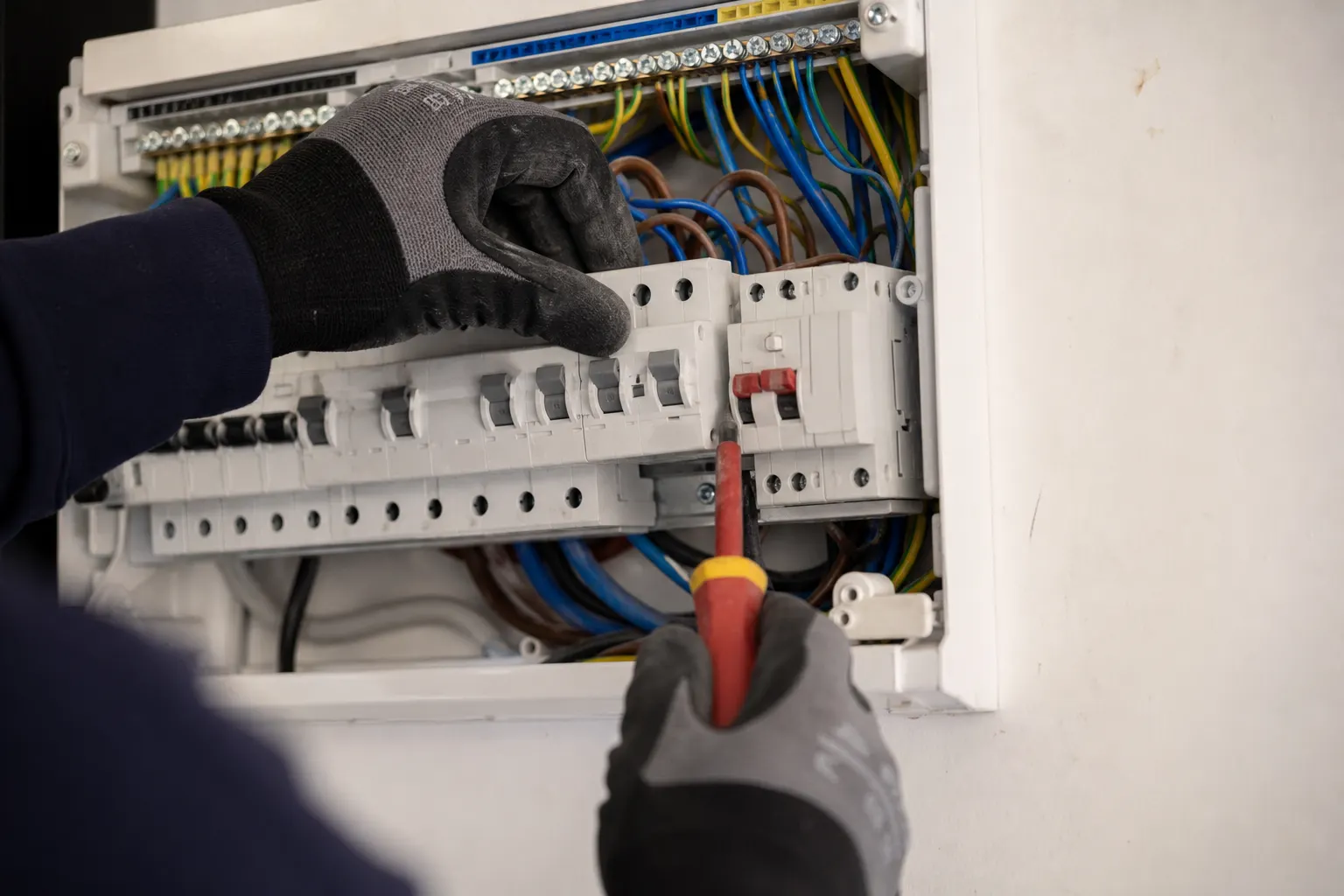
A consumer unit upgrade means removing the existing board and fitting a new one in its place, then reconnecting the circuits that run through your property: lighting, sockets, the cooker, the shower and so on. The old unit may have rewirable fuses, or it may be an early model with few protective devices. The new one will normally have circuit breakers and RCD protection, which cut the power quickly if a fault develops.
The work starts with isolating the supply, so the power will be off for part of the job. Plan around that: bring forward anything you need to charge, and think about freezers, alarms, broadband equipment and anyone in the property who relies on electrically powered medical devices.
The existing cables are then checked for suitability and connected to the right protective devices in the new board. Once everything is connected, the circuits are tested before the supply is restored. A consumer unit is usually a like-for-like swap in the same position, though sometimes the position, the size of the board or the tails feeding it need attention.
When to get in touch
Some signs make an upgrade worth asking about sooner rather than later. A board with old rewirable fuses is one. So is a unit with a cracked or damaged casing, scorch marks, a burning smell, or breakers that trip repeatedly for no clear reason. If a fuse keeps blowing, do not keep replacing it with a higher-rated one. Switch off the affected circuit and ask an electrician to look at it.
Other moments are more practical than urgent. You might be adding a shower, an electric vehicle charger or a kitchen extension and find the board has no spare ways. You might be buying a property with an old fuse box, or letting one and want the installation looked at properly. You might simply have a unit that is full, with circuits doubled up on one breaker.
If you smell burning from the board, see smoke or notice it feels hot, treat it as an emergency, switch off at the main switch if it is safe to do so, and contact the emergency services if there is any sign of fire.
How an EICR connects to a consumer unit upgrade
An Electrical Installation Condition Report, or EICR, is an inspection of the fixed wiring in a property and the report that comes from it. Because the consumer unit is at the heart of the installation, the report often comments on it. An inspector may note that the board lacks RCD protection, has an unsuitable enclosure, or has damaged or poorly connected parts.
That is why many consumer unit upgrades begin with an inspection. If you already have an EICR that mentions the board, send the details with your enquiry. If you do not, an EICR first can give a clearer picture of what the whole installation needs, not just the board.
Landlords, and people buying or selling, often find the two jobs go together. Our Landlord EICR and EICR for Buying or Selling services cover the inspection side, and a consumer unit upgrade can follow where the report points to one.
What affects the cost, and why follow-up work is separate
The cost of a consumer unit upgrade depends on a few things you can describe in an enquiry. These include the number of circuits, the type and size of the new unit, whether extra protective devices are wanted, how easy the existing board is to reach, and whether the board needs to move. The condition of the cables and the earthing and bonding arrangements also matter.
The price for replacing the unit is a different matter from any remedial work that turns up along the way. When a board is opened and tested, it can show problems that were not visible before: a damaged cable, a circuit with poor insulation, missing bonding or a loose connection. Fixing those is extra work in addition to the upgrade itself.
A sensible approach is to ask for the scope in writing, with the consumer unit replacement described on its own and any further work listed separately once it is identified. That way you can see what is needed to complete the upgrade and what is optional or can be planned for later. Prices are best discussed once the details of your property are known, so describe it as fully as you can in the form.
Rules, paperwork and what to ask any electrician
Replacing a consumer unit is the kind of work that is covered by the Building Regulations in England, so it should be done by a competent person and recorded properly. The rules can change, so check GOV.UK for the current position before you commission any electrical work.
Whoever you choose, it is reasonable to ask what the job includes, which circuits will be protected by which devices, and what paperwork you will receive when the work is finished. Keep that paperwork safe. Your insurer, a buyer, a letting agent or a future electrician may all ask to see it.
Also ask to see proof of any registration an electrician says they hold, and check it with the scheme concerned. Before the day, clear the area around the board, tell everyone in the property that the power will be off, and make sure someone can give access.
Questions about this
Do I need a new consumer unit if my fuse box still works?
Not always, but a board that works is not necessarily one that protects well. Old units may lack RCD protection or modern breakers. If yours is old, damaged or full, or an inspection has flagged it, an upgrade is worth asking about. An EICR can help you decide.
Will the power be off while the work is done?
Yes. The supply has to be isolated while the old unit is removed and the new one connected, so the power will be off for part of the job. Plan ahead for anything that needs electricity and tell everyone in the property.
Is a consumer unit upgrade covered by the Building Regulations?
Replacing a consumer unit has long been treated as notifiable work in England, so it should be carried out and recorded properly by a competent person. Rules can change, so check GOV.UK for the current position.
Can I get a consumer unit upgrade in a rented property?
If you are a tenant, speak to your landlord first, as the installation belongs to the property. Landlords can send an enquiry for the upgrade, and where an inspection is needed we also offer Landlord EICR.
What you get
Part of a wider electrical service
Consumer unit upgrades sit alongside EICR, Landlord EICR, EICR for Buying or Selling, Commercial EICR and general electrician work, so one enquiry can cover related jobs.
Covering Romford and nearby towns
We serve Romford, Hornchurch, Upminster, Gidea Park and Harold Wood across East London.
One simple way to get started
Use the enquiry form on this page to describe your property and your existing fuse box, and say what prompted the enquiry.